Modern office environments have undergone a dramatic structural transformation. The focus has decisively shifted from basic video presence (simply showing up on a webcam) to achieving true meeting equity. As organizations navigate the operational complexities of distributed teams, hybrid workspace communication has emerged as the cornerstone of productive, long-term collaboration.
When virtual interaction replaces face-to-face contact, communication breakdown rarely stems from low screen resolution; it stems from unintelligible voice clarity. Implementing enterprise-grade audio infrastructure bridges the physical and digital divide, ensuring every participant (whether sitting in a headquarters boardroom or joining from a home office) remains an equal contributor to the conversation.
The Root Challenge: Why Audio Outweighs Video in Meeting Equity
The primary challenge facing modern enterprises is maintaining seamless intelligibility across mixed-environment meetings. Extensive workplace studies confirm that most meeting fatigue and miscommunications are driven by poor audio quality rather than camera performance.
When voice clarity degrades, the brain must work significantly harder to fill in missing syllables and filter out ambient distractions. This visual and auditory fatigue creates subtle hierarchies within meetings, where remote workers struggle to interrupt or contribute, while in-room speakers dominate the flow.
To solve this gap, organizations must look beyond consumer-grade soundbars and perimeter mics. Achieving true acoustic parity requires:
- Targeted Acoustic Treatment: Dampening ambient echo, HVAC rumble, and hard-surface reflections.
- Intelligent Digital Signal Processing (DSP): Filtering unwanted signals dynamically without clipping natural speaking tones.
- Dynamic Beamtracking Technology: Tracking active voices dynamically in 3D space rather than relying on static, omnidirectional pickup zones.
The Biamp Ecosystem: Engineering Parity in Modern Workspaces
Achieving a frictionless hybrid experience requires an integrated architectural approach rather than piecemeal hardware assembly. Biamp offers an end-to-end audio and management ecosystem designed to address the mechanical, acoustic, and administrative demands of contemporary facilities.
Advanced Audio Capture and Acoustic Noise Elimination
By deploying Tesira digital signal processors (DSPs) alongside Parlé beamtracking microphones, organizations ensure voice signals are captured accurately, regardless of speaker position or movement.
Unlike fixed directional microphones, Parlé arrays utilize multi-zone tracking that follows speakers as they walk around a room or shift in their seats. Simultaneously, Tesira DSP algorithms evaluate the incoming audio signal in real time to resolve three critical challenges:
- Acoustic Echo Cancellation (AEC): Eliminates double-talk feedback without dropping voices or cutting off conversational overlaps.
- Dynamic Noise Suppression: Filters out background sounds, such as mechanical HVAC systems, keyboard clicking, and exterior traffic, without thinning out natural vocal resonance.
- Automated Gain Control (AGC): Automatically balances soft-spoken presenters with louder room participants so the far-end receiving volume remains consistent.
Implementing professional sound systems by Biamp allows teams to bridge the gap between physical and virtual spaces, ensuring that every participant feels like an equal contributor to the conversation. When technical friction is removed from the audio stream, collaboration becomes intuitive, letting participants focus on critical business discussions rather than asking, “Can you hear me now?”
Centralized Management and Enterprise Flexibility
Beyond acoustic performance, modern enterprise IT departments require centralized tools to deploy, monitor, and scale AV assets across global real estate portfolios.
As organizations refine their long-term hybrid models, the necessity of a unified technology stack becomes clear. Biamp Workplace serves as a vital operational management layer, uniting physical room scheduling, hardware telemetry, and remote maintenance into a single, secure cloud platform.
Key Strategic Benefits
| Strategic Pillar | Enterprise Impact |
| Reduced Administrative Overhead | Mass-deploy firmware updates, monitor device health proactively, and resolve room issues remotely before meetings are impacted. |
| Seamless Employee Transitions | Standardizes UI/UX across huddle spaces, training rooms, and executive boardrooms so staff can join meetings instantly without tech support. |
| Data-Driven Room Insights | Gathers occupancy data, environmental metrics, and usage analytics to help facility managers optimize space utilization and room comfort. |
Designing Purpose-Built Spaces Across the Portfolio
A standard enterprise facility includes varied acoustic environments, each presenting unique engineering demands. Standardizing on a versatile hardware architecture allows IT teams to scale solutions to match specific spatial footprints:
1. Huddle Rooms & Focus Spaces
Small-footprint spaces benefit from streamlined, all-in-one conferencing bars that incorporate Parlé microphone arrays, clear full-range speakers, and integrated camera tech into a plug-and-play USB deployment.
2. Flexible Medium & Large Conference Rooms
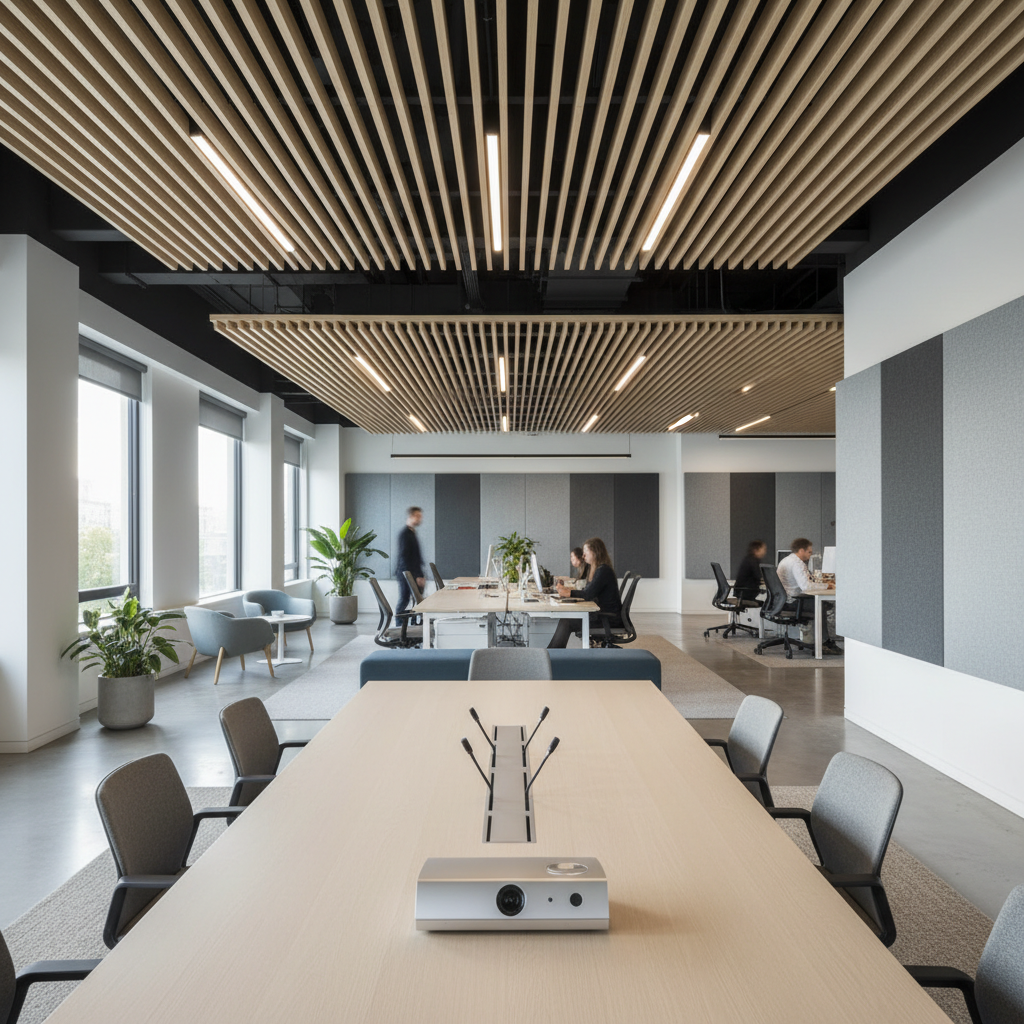
In medium-to-large spaces, dynamic voice coverage is essential. Flush-mounted ceiling or tabletop Parlé microphones pair directly with network-attached Tesira amplifiers and desk-mounted control panels, keeping cables hidden and surfaces clear.
3. Open Collaboration Zones & High-Noise Areas
Creating effective conferencing zones within modern, open floor plans requires precise acoustic boundaries. Microphones with hyper-focused beam-steering, paired with directivity-controlled loudspeakers, create localized acoustic “bubbles” that contain sound without spilling into surrounding workspaces.
Building a Resilient, Future-Proof Infrastructure
The success of any hybrid workplace hinges on the reliability and predictability of its underlying infrastructure. Whether retrofitting an existing building or standardizing AV technology across a global real estate portfolio, the primary goal remains identical: building an invisible, high-performing environment where technology steps back, and natural communication takes over.
Investing in professional, ecosystem-based sound systems equips your enterprise to foster a truly inclusive, highly efficient culture, ensuring every voice is heard clearly, regardless of where team members log in each day.